

By December 7, 2025, O’Hare had already logged 17.1 inches of snow, the quickest start to a Chicago winter since 1978, according to the National Weather Service. That year means something to us. It is the year Mitchell Construction started building decks in Chicago’s southwest suburbs, and after nearly five decades of storms, our crews have seen every way a winter can punish an outdoor living space.
If you are planning a new deck and want the best deck material for snow, this guide covers what ice does to each material, how much weight your deck can carry, and which boards and framing earn a spot behind a home in Frankfort, Naperville, or Orland Park.
What a Chicago Winter Does to a Deck
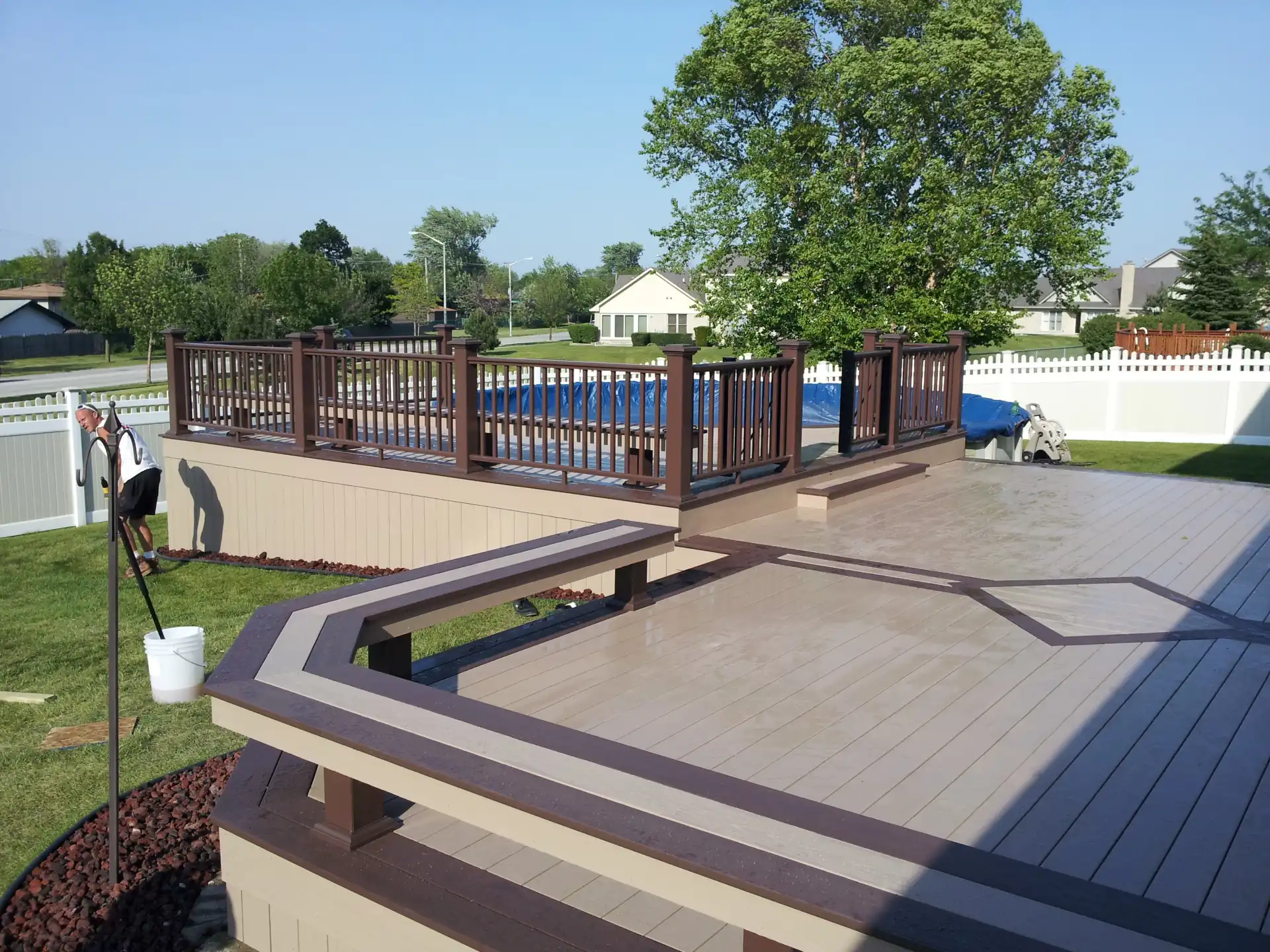
Snow itself is rarely the villain. The damage comes from the cycle around it. Snow melts on a sunny 38-degree afternoon, water slips into wood fibers, joints, and screw holes, then refreezes overnight. Water expands about 9% as it turns to ice, and every expansion pries those openings a little wider. Repeat that dozens of times between November and March, and you get checking, split board ends, popped fasteners, and soft spots where rot takes hold.
Good cold decking has to do three things: shed water instead of absorbing it, stay stable when temperatures swing 50 degrees in a week, and keep its grip under slush. Every option below is measured against that standard.
The Snow Storm Challenge: How Each Material Holds Up
| Material | Moisture Behavior | Freeze-Thaw Risk | Winter Care |
| Pressure-treated wood | Absorbs water into open grain | High: checking, splitting, rot | Seal every 2-3 years, clear snow fast |
| Cedar | Absorbs water as natural oils fade | Moderate to high | Stain and seal every 2-3 years |
| Trex capped composite | Protective shell blocks surface moisture | Low | Plastic shovel, spring wash |
| Evalast | Waterproof core resists swelling | Low | Soap-and-water cleaning |
| MoistureShield | Encapsulated core blocks water from every side | Very low | Soap-and-water cleaning |
| PVC (TimberTech AZEK) | No wood content, absorbs almost nothing | Very low | Plastic shovel, spring wash |
How Long Does a Wood Deck Last in Snow?
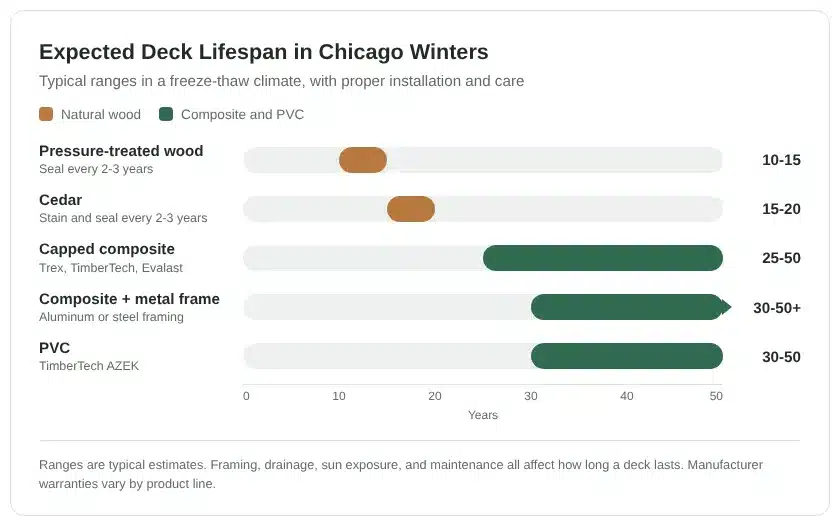
The honest answer is shorter than most homeowners expect. In a mild climate, a well-kept pressure-treated deck can pass 20 years. Around Chicago, where boards face months of snow cover, freeze-thaw, and ice melt, 10 to 15 years is more realistic, and only if you reseal every two to three years.
The weak point is often hidden. Even under composite boards, a wood frame keeps soaking up meltwater at the joists and ledger. That is why we pair winter-ready boards with aluminum and steel deck framing, Trex RainEscape (an over-the-joist drainage system backed by a 20-year warranty), and helical piers set below the frost line, which reaches 42 inches in much of Chicagoland. A frame that never rots and footings that never heave let your boards reach their full lifespan.
Expected Deck Lifespan in a Freeze-Thaw Climate
Best Deck Material for Snow: Our Top Picks
Trex: The proven all-rounder. As a TrexPRO Platinum builder, the highest recognition Trex awards, our team has completed Trex’s advanced product and installation training. Trex boards are made from 95% recycled materials and resist rot, splitting, cracking, warping, and mold. Trex Limited residential warranties run 25 to 50 years with fade and stain coverage.
Evalast: Built for temperature extremes. Evalast is rated from -40°F to 140°F and moves only about 0.02 inches per foot across a 100-degree swing. Its Extreme line is engineered for harsh climates, and the boards carry ASTM D7032 ratings of 100 psf uniform live load and 300 pounds concentrated over a 12-by-12-inch area.
MoistureShield: When water is the main enemy. For low decks near grade, pool decks, or shady corners where snow lingers into April, MoistureShield’s encapsulated core is rated for ground and water contact.
TimberTech: Composite and PVC choices. TimberTech offers capped composite and AZEK PVC lines with textured, slip-resistant surfaces. PVC expands and contracts more than composite, so exact end gaps matter when the same deck sees humid 90s in July and subzero nights in January.
Pro Tip: Darker boards absorb more winter sun and clear snow faster after a storm. If your deck faces north or sits in shade, a mid-tone or dark color will melt off days sooner than a pale gray.
How Much Snow Can a Deck Hold?
Most residential decks are designed for a 40 psf live load, and codes require the structure to handle the live load or the local snow load, whichever is greater. Using FEMA’s widely cited rule of thumb, here is how quickly different snow types add up.
| Snow Condition | Approx. Weight | Depth to Reach ~40 psf |
| Fresh, fluffy snow | 5-6 lb per cubic foot | 7-8 feet |
| Settled or packed snow | 12-20 lb per cubic foot | 2-3.3 feet |
| Wet, heavy spring snow | About 20 lb per cubic foot | About 2 feet |
| Solid ice | About 60 lb per cubic foot | About 8 inches |
Covered decks add a second load to plan for. The roof has to carry its own snow load, which local codes base on a ground snow load of roughly 25 psf across much of northeastern Illinois, and every pound travels down the posts to the footings. Steeper pitches shed snow faster, but the slide piles it at the drip edge, so we size the beams and footings below for that heavy strip too.
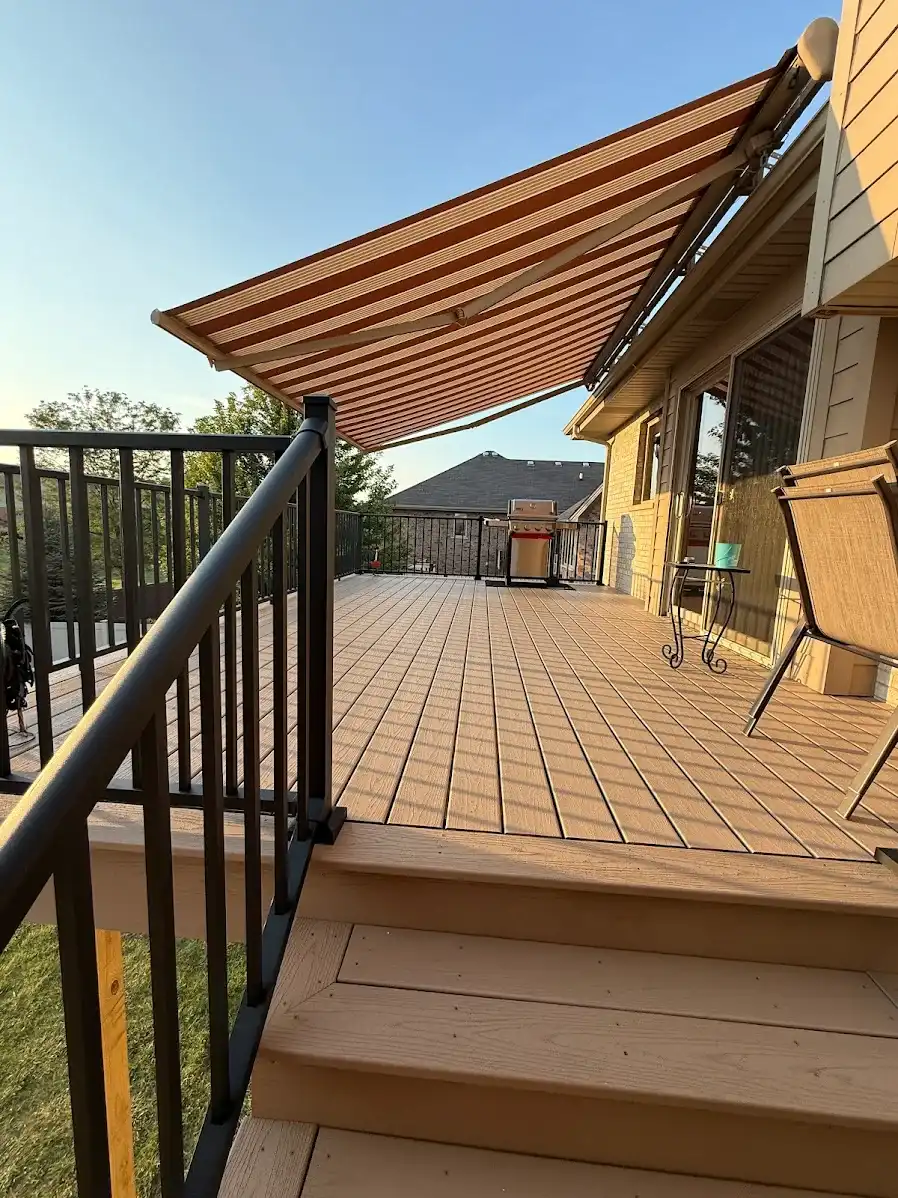
Pro Tip: Watch for drifts against the house and under roof edges. Those spots can carry double the load of the open deck and sit right on top of the ledger board, your deck’s most important connection.
Winter Deck Ideas That Make Snow Season Worth It
A weather-proof deck should earn its keep in January, too:
- Covered decks and pavilions that give you dry seating all winter, plus a DrySpace underdeck ceiling to keep the patio below dry.
- Fire pits and fireplaces that turn a 25-degree evening into a gathering spot.
- Deck lighting on stairs and posts, since Chicago sunsets hit around 4:20 p.m. in December.
- Sunrooms and enclosures that extend outdoor living year-round.
Pro Tip: Before the first storm, blow leaves and debris out of the board gaps. Trapped organic matter holds meltwater against the boards and framing all winter and leaves stains behind in spring.
Is a Composite Deck Worth It in Chicago?
The numbers say yes. In the 2025 Cost vs. Value Report, a composite deck addition in Chicago averaged $24,337 and returned $22,242 at resale, recouping 91.4% of its cost, ahead of the 88.5% national average. Add years without sanding or sealing, a 10-year labor warranty from our crew, and financing through Synchrony with no monthly interest if paid in full within 18 months (subject to credit approval), and the math gets easier.
Cold Decking FAQs: Snow, Ice, and Your Next Deck
What is the best deck material for snow in Chicago?
It depends on the deck. For an elevated deck, go with Trex or TimberTech on aluminum framing. For a ground-level deck in shade, MoistureShield is the safer bet. If budget is the deciding factor, Evalast’s Classic line gives you the same weather durability at a lower price.
Can I shovel my composite deck?
Yes. Use a plastic shovel and push along the length of the boards, not across them. Skip metal blades and ice choppers, since they can gouge the protective cap and void parts of your warranty.
Will ice melt damage composite decking?
Calcium chloride is your safest choice and is approved by most composite manufacturers. It may leave a white film, which rinses off in spring. Avoid sand, which scratches the surface, and always check your board’s care guide.
Do I need to clear snow off my deck at all?
For light snowfalls, no. A properly built deck can carry it, and composite will not rot underneath. Clear it once you have more than a foot of heavy, wet snow, when ice starts building up, or when drifts pile against the house. Clear stairs and walkways after every storm for safety.
Can you build a deck during a Chicago winter?
Sometimes. Helical piers can go in when frozen ground would stop concrete footings. Most homeowners use the winter months for design, and since we handle drawings, engineering, permits, and inspections, planning now puts you first in line for a spring build.
Does composite decking get slippery in snow and ice?
Any surface under ice is slippery, but embossed grain on capped composite and PVC gives better traction than worn, mossy wood. Clear snow before foot traffic packs it into ice.
Build a Deck That Laughs at Lake-Effect Snow
From Frankfort and Tinley Park to Plainfield and Dyer, our in-house carpenters design and build decks for lake-effect storms, freeze-thaw swings, and everything in between. Schedule your consultation today!